



The Next Pope has Already Been Chosen

Many Names, One Mother: A Cuban Reflection for the Feast of Mary’s Nativity

Photo by Karla Villaizan on Unsplash
“Our Lady of Charity of El Cobre… Queen and Mother of all Cubans… guides and sustains… the steps of her sons and daughters towards our heavenly homeland.” Saint John Paul II (From his historic homily in El Cobre, Cuba, 1998)
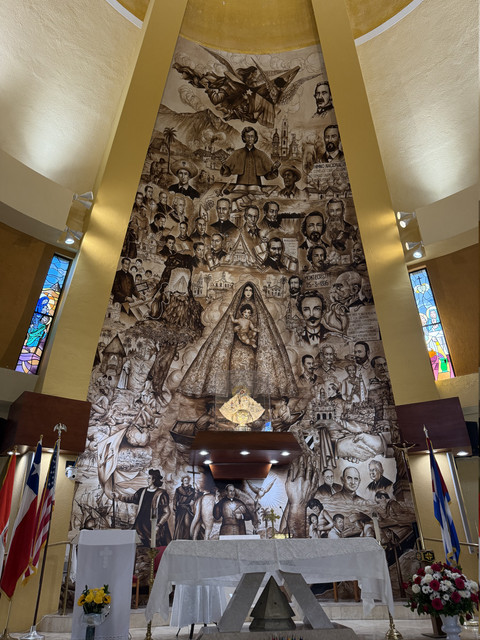
September 8 marks the Feast of the Nativity of the Blessed Virgin Mary, but for me and my fellow Cubans, this day carries double the meaning. On this feast, we also honor Our Lady under the title La Virgen de la Caridad del Cobre (Our Lady of Charity of El Cobre). As the patroness of my home country, she was a constant presence in my childhood. In fact, when my family moved to Miami, one of the first places we visited was La Ermita de la Virgen de la Caridad (The Shrine of Our Lady of Charity), which was founded in 1967 by the Most Reverend Coleman F. Carroll.
Although she is often depicted floating above a canoe with three men caught in a storm at sea, the story of Our Lady of Charity is not a traditional apparition. Rather, it is a miraculous answer to a desperate plea for survival on the open sea.
In the early 1600s, two Indigenous Cubans, Rodrigo and Juan de Hoyos, and a ten-year-old African slave, Juan Moreno, went to collect salt in the Bay of Nipe. While at sea, a violent storm suddenly overtook their small boat. Trapped in a blinding downpour with waves crashing over the sides, the group prayed fervently before an image of the Virgin Mary carried by the young slave.
Suddenly, the skies parted, the waters calmed, and the group spotted what appeared to be a white bird floating on the distant waves. Drawing closer, they realized it was not a bird, but a small statue fixed to a wooden board. Inscribed upon it were the words: “Yo Soy la Virgen de la Caridad” (“I am the Virgin of Charity”). Despite the storm, the statue and its robes were completely dry.
The men brought the statue ashore, and devotion to Our Lady of Charity spread rapidly across the island. The image was eventually brought to the mining town of El Cobre—named for its rich copper deposits—where a permanent shrine was built. Early history recalls times when the statue mysteriously vanished from the locked church, only to reappear later—marking the locations where even richer deposits of copper could be found.
Our Lady reflects the people who love her: she is richly dressed in golden silken robes, with dark skin, holding a sun-tanned Infant Jesus in her arms. She smiles down on her Cuban children, who turn to her in every generation with deep confidence and love.
In 1916, Pope Benedict XV declared Our Lady of Charity the patroness of Cuba. Decades later, in 1977, Pope Paul VI officially elevated her shrine in El Cobre to the status of a Minor Basilica.
I left Cuba at seven years old and never had the opportunity to visit El Cobre, which lay on the far eastern side of the island from where I lived. But I vividly remember visiting another Marian shrine not far from my birthplace near Havana. To reach it, we had to take a small boat across Havana Bay to the town of Regla. There, Cubans venerate Our Lady of Regla, whose feast day also falls on September 8th.
Though less universally famous than Our Lady of Charity, her story is rich in history. According to Catholic tradition, Saint Augustine of Hippo—living in North Africa—received a vision from an angel prompting the creation of a statue of the Blessed Mother. Thirteen years after Augustine's death, his disciple Saint Cyprian brought the image to Spain to protect it from invading vandals. He established a monastery in Chipiona, Andalusia, where devotion to the Virgin of Regla took root. The statue’s dark skin reflects her North African origin, echoing the words of Solomon: “I am black and beautiful, Daughters of Jerusalem, like the tents of Qedar, like the curtains of Solomon” (Song of Songs 1:5). Local tradition holds that her name, Regla (meaning "rule" in Spanish), pays tribute to the Augustinian Rule of Life.
In 1687, a pilgrim named Manuel Antonio built the first hermitage dedicated to the Virgin of Regla on the shores of Havana Bay. Though a violent hurricane destroyed it a few years later, the shrine was rebuilt in 1694 to house a new statue donated by Don Pedro de Aranda. By 1714, Our Lady of Regla was officially declared the patroness of the town, earning her lasting title as the protector of sailors and the sea.
As we celebrate the Nativity of Our Blessed Mother, I am reminded of the countless titles she bears across the globe. Yet whether we call upon her as Our Lady of Charity, Our Lady of Regla, or any other beloved name, she remains our single Mother in heaven—watching over, protecting, and interceding for all her children, no matter where life's currents take us.
Happy Birthday Mama Mary!!!
Copyright © 2026 Christy Romero. All rights reserved. Ad Majorem Dei Gloriam. If you thought of someone while reading this, bless them by sharing it with them.
Sources & References:
- EWTN News: "Who is Our Lady of Charity of El Cobre?"https://www.ewtnnews.com/world/us/who-is-our-lady-of-charity-of-el-cobre
- Saint John Vianney College Seminary: "Our Lady of Charity" by Fr. Jorge Perales https://www.sjvcs.edu/the-disciple/our-lady-of-charity
- Roman Catholic Saints: "Our Lady of Charity, Cobre, Cuba"https://www.roman-catholic-saints.com/our-lady-of-charity.html
- Catholic Resources: "Our Lady of Regla"https://spiritualreading.co.za/images/our-lady-of-regla/
About the Author


