



Rainbow Coincidence Over Pope Francis’ Hospital

Preview of Mel Gibson's Fall of the Angels Scene


What to Expect from Mel Gibson's Fall of the Angels Scene
Mel Gibson's long expected The Resurrection of the Christ will open in theaters on May 6, 2027 (Part One) and May 25, 2028 (Part Two). Both dates fall on the traditional Thursday observance of the Ascension.
Gibson has said that his story reaches back to the fall of the angels. That raises an irresistible question: how does a filmmaker show a rebellion among beings without bodies? Will it resemble a battle, a sudden plunge from heaven, or something stranger?
For this scene, as with many in The Passion of the Christ, Gibson will most likely rely on three primary sources: Scripture, Sacred Art and the Writings of a 19th century mystic named Blessed Ann Catherine Emmerich.
Most people who have seen The Passion of the Christ would agree that it contains probably the creepiest portrayal of Satan as a bald, hooded, androgynous, devoid of eyebrows, staring eyes never blinking, slow moving predator. Who can forget Satan drifting through the crowd holding a grotesque, 40-year-old "man-child" with an aged face and a hairy back. There’s no doubt that Mel Gibson’s imagination for how evil should be portrayed on film is jarring yet true to scripture and tradition. This is why the opening scene in his new film, The Resurrection of the Christ is highly anticipated.
What will Mel do to portray the epic and cosmic fall of Satan and the demons at the outset of time? What will the arch-angel Michael look like? How is the battle scene going to appear? Will it be like a preternatural Braveheart battle scene full of warrior angels colliding with weapons swinging? Will it have a zoomed in climatic moment of St. Michael casting out Satan as portrayed so often in art?
No one has ever seriously tried to portray this angelic clash on film. Mel Gibson has spent the last 20 years meditating on this sequel to The Passion of the Christ and on mulling over this opening scene in particular. It is ambitious but somehow I think and expect that it will be believable and awesome. It was said that crafting the sequence was so intense and disturbing on an IMAX screen that it caused Gibson to pause and rewrite it multiple times.
Scripture on 'The Fall of the Angels'
Mel Gibson will use Scripture as a guide and inspiration for the fall of the angels scene beginning with Isaiah who addresses Satan directly:
“How you are fallen from heaven, O Day Star, son of Dawn! How you are cut down to the ground, you who laid the nations low! You said in your heart, ‘I will ascend to heaven; above the stars of God I will set my throne on high; I will sit on the mount of assembly in the far reaches of the north. I will ascend above the heights of the clouds; I will make myself like the Most High.’ But you are brought down to Sheol, to the far reaches of the pit” (Isaiah 14:12-15).
As far as the scale of the number of angels in the battle and the amount that fell he will probably rely on the Book of Revelation 12:3–4, 9 which describes a great red dragon whose tail sweeps a third of the stars from the sky and flings them to the earth. So, taken literally, we have 66% of the angels as good defeating 33% that are wicked and rebellious.What does the actual fall look like? Powerful, quick, explosive, loud, frightening like a lightning strike. Christ, himself said;
“I saw Satan fall like lightning from heaven” (Lk 10:18).
Will Gibson portray the locking up of the demons in hell?
“For if God did not spare angels when they sinned, but cast them into hell and committed them to chain of gloomy darkness to be kept until the judgment” ( 2 Peter 2:4).
Blessed Ann Catherine Emmerich on 'The Fall of the Angels'
Blessed Ann Catherine Emmerich was a 19th-century German mystic who had visions, not just of Christ's suffering which Mel Gibson used heavily in The Passion of the Christ, but also of the the rebellion of Lucifer, and the fall of the angels (compiled in her broader works like The Life of the Blessed Virgin Mary).
It stands to reason that Gibson will use the following short description, written by Emmerich herself, of her vision of the fall of the angels as a guide for the opening scene of The Resurrection of the Christ:
“Ihese choirs came forth from the higher Sun, as if born of love. Suddenly I saw some of them pause, rapt in the contemplation of their own beauty. They took complacency in self, they sought the highest beauty in self, they thought but of self, they existed but in self. At first all were lost in contemplation out of self, but soon some of them rested in self.
At that instant, I saw this part of the glittering choirs hurled down, their beauty sunk in darkness, while the others, thronging quickly together, filled up their vacant places. And now the good angels occupied a smaller space. I did not see them leaving their places to pursue and combat the fallen choirs. The bad angels rested in self and fell away, while those that did not follow their example thronged into their vacant places.
All this was instantaneous. Then rising from below, I saw a dark disc, the future abode of the fallen spirits. I saw that they took possession of it against their will. It was much smaller than the sphere from which they had fallen, and they appeared to me to be closely crowded together. I saw the Fall of the angels in my childhood and ever after, day and night, I dreaded their influence. I thought they must do great harm to the earth, for they are always around it. It is well they have no bodies, else they would obscure the light of the sun. We should see them floating around us like shadows..."
Sacred art on 'The Fall of the Angels'
Gibson’s cinematic approach is to create movie scenes that mirror classical Catholic and Renaissance sacred art which have shaped the Catholic imagination for centuries. In The Passion of the Christ we find a pattern of sets and locations that mimic paintings by Caravaggio, Grünewald, and Giotto to create an epic cinematic effect.
There's no doubt that Gibson studied these paintings in preparation for the film...
Giotto di Bondone’s The Last Judgment Fresco (c. 1305–1306) Located on the west wall of the Scrovegni (Arena) Chapel in Padua. The upper portion shows the orderly heavenly host, while the bottom right depicts a chaotic, terrifying vision of Hell. Here, demonic figures and doomed souls are violently plunged into an infernal abyss, mirroring the physical visual language later used to describe the fall of the rebel angels.
Matthias Grünewald’s The Isenheim Altarpiece – Concert of Angels (c. 1512–1516) features gothic shadows and architectural background of the chapel which is surrounded by feathered, bird-like, and heavily shadowed angels that art historians identify as a depiction of Lucifer and the falling rebel angels.
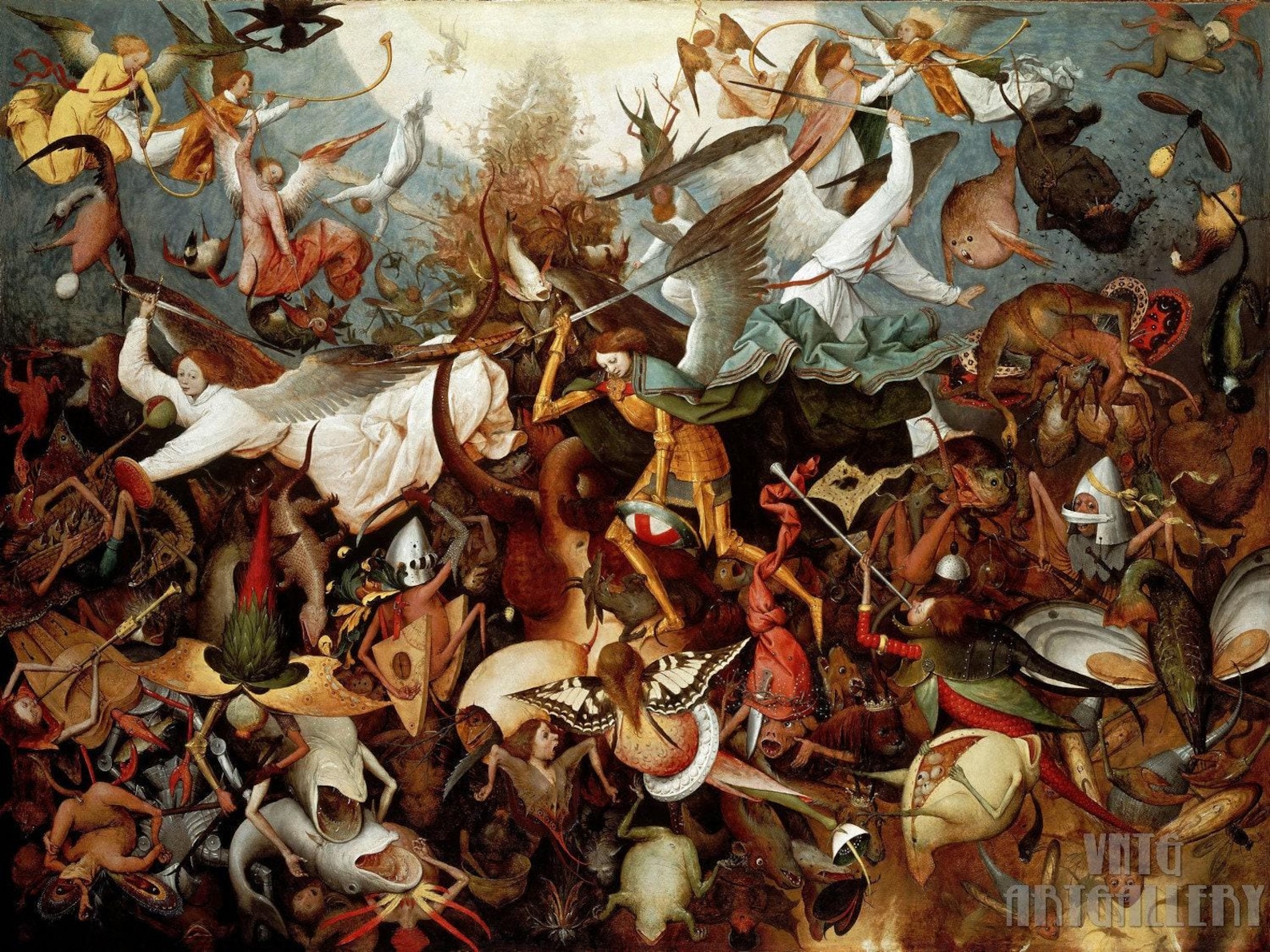
ABOVE - Pieter Bruegel the Elder: The Fall of the Rebel Angels (1562) is a chaotic masterpiece in Brussels showing angels transforming into bizarre, monstrous creatures as they fall from heaven.
ABOVE - Peter Paul Rubens's The Fall of the Damned (1620)—a monumental Baroque canvas in Munich showing a cascading waterfall of tangled bodies cast out by Archangel Michael.
No one really knows what will exactly happen in this opening scene except Mel and his close inner circle but you are guaranteed to recognize the inspiration drawn from these sources of scripture, art and the extra-biblical memoirs of an obscure mystic. We will leave it to Gibson to bring them together in a cosmic, epic masterpiece of film. No pressure Mel.
About the Author


