



Corpus Christi: A Cross in the Darkness

The Community I Didn’t Know I Had
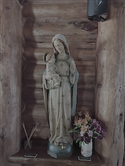

Photo by Kelly Sikkema on Unsplash
Today is St. Faustina’s feast day.
I have come to love this woman so much. Her story inspires me on so many levels, but perhaps especially because she has helped me understand something I did not fully appreciate before becoming Catholic: the Christian community is much larger than the people we can see.
Nearly all of my family and friends outside the community where I live now are Protestant. Personally, I do not particularly like making that distinction. If we are in Christ, we are Christians. Sadly, history has made distinctions necessary because Christians are no longer united in practice or theology. I know the consequences of those divisions personally. I grew up believing Catholics were not Christians. The historian in me now notices how complicated that assumption is. Even after the English Reformation, for example, many elements of Catholic liturgical life remained recognizable within the Church of England. Even within modern Protestant traditions, echoes of older Christian practices remain. I sometimes think of the altar call common in Baptist and Evangelical churches: people are invited to come forward, toward the altar, to receive Christ into their lives. As a Catholic convert, the imagery strikes me differently now because every Mass culminates in a movement toward the altar, where Catholics believe we receive Christ- Body, Blood, Soul, and Divinity- in the Eucharist. There are many other connections I have begun noticing. But this is not a post comparing Protestant and Catholic practices. It is about something I have been learning in the desert of my own life.
Over the past few years, living far from the only home I knew for nearly forty years, I have learned how much we need community. Only Jesus saves us. He is the way to the Father. But Christ did not design the Christian life to be lived entirely alone. We need people to walk beside us. That has never come naturally to me.
I am an introvert. Those who know me best know how much I have struggled with shyness throughout my life. I have passed up opportunities because I was afraid to speak or step forward. Motherhood and my professional life have forced me to stretch beyond that comfort zone, but I can still happily remain inside my house for weeks. The cloistered housewife has a nice ring. It is probably part of the reason I am drawn to writing and social media. Writing allows me to communicate thoughts that sometimes struggle to find their way out of my mouth. I know I am not alone in that. This is one reason I have come to appreciate our dearly departed brothers and sisters in Christ, saints like Faustina.
St. Faustina has also taught me something about the kind of God who meets us in those lonely places: a God of mercy.
Divine Mercy is sometimes spoken about as though it were simply a particular Catholic devotion: the image, the chaplet, the novena, Divine Mercy Sunday. But the message at its heart is much bigger. It is the Gospel itself: we have a Savior whose mercy is greater than our sin, our weakness, our fear, and our failures. That has become especially meaningful to me in this season of my life. A desert has a way of exposing everything. The things we use to distract ourselves disappear. Our weaknesses become harder to hide. Loneliness becomes louder. We discover how little control we actually have. Perhaps that is exactly where mercy becomes more than a theological idea. It becomes something we need.
Faustina's life continually points back to trust in Christ's mercy. That may be what draws me to her most. Divine Mercy does not tell us that our wounds, sins, or struggles do not matter. It tells us that none of them are greater than Christ. The words beneath the Divine Mercy image are remarkably simple:
Jesus, I trust in You.
That is one of the hardest prayers to actually live.
Jesus, I trust in You when I understand.
Jesus, I trust in You when I do not.
Jesus, I trust in You when the road feels full.
And Jesus, I trust in You when the road feels like a desert.
Faustina has also helped me understand something else about those desert places: We are not walking through them alone.
Through the writings and lives of the saints, we learn how others walked with Jesus before us. Reading their letters, diaries, prayers, and struggles reminds me in some ways of reading the letters of the New Testament. They were real people trying to follow Christ through suffering, uncertainty, temptation, joy, failure, and grace. But Catholicism taught me something even more beautiful. They are not merely people from the past. They are part of the Church.
We hear something interesting even within Protestant culture when someone we love dies. We say, “They are with Jesus now.” We speak of them as being in heaven. We believe death has changed our relationship with them, but we do not believe it has erased their existence. Scripture gives us an extraordinary image of this in Hebrews. After recounting the faithful who came before us- Abraham, Sarah, Moses, Rahab, and so many others- the writer begins the next chapter:
“Therefore, since we are surrounded by so great a cloud of witnesses…” (Hebrews 12:1).
I used to read that verse primarily as an encouragement to imitate the faith of those who had gone before us. And it certainly is that. But as a Catholic, the image has become much richer to me. We are surrounded. The Christian life is not presented as a solitary race. Hebrews describes the faithful who have gone before us and then pictures us running our own race surrounded by this great cloud of witnesses. They finished before us. We are still running. Yet, somehow, in Christ, we remain part of the same story.
Revelation gives us another glimpse of this heavenly communion, describing the prayers of the saints being offered before God. The picture is not of heaven disconnected from earth, but of the people of God united in worship before Him. Death has not removed these people from the Body of Christ. They are alive in Him. They are alive WITH Him. That changed the way I understood asking the saints for their prayers.
When I ask a friend, “Will you pray for me?” I am not replacing Jesus with my friend. I am asking another member of the Body of Christ to join me in prayer. So why would death suddenly end that fellowship? Why would I gladly ask someone sitting beside me at church to pray for me, yet reject the possibility of asking someone who has finished the race and is already with Christ to do the same?
Jesus remains the center.
Jesus remains the Savior.
Jesus remains the mediator through whom salvation comes.
The saints do not compete with Him. Their entire lives point toward Him. Maybe that is precisely what the image in Hebrews is meant to remind us of. We are running toward Him, but we are not running alone. We are surrounded by a great cloud of witnesses. Do I have to ask St. Faustina to pray for me? No. But I have come to ask a different question: Why would I not want to?
My community consists of my household, my parish, my small town, my workplace, and people scattered across states and across the country. Not everyone can walk beside me through every season. Not everyone understands every part of my journey. But the Church is larger than my town. It is larger than my parish. It is larger than my country. It is even larger than this life. That may be one of the most comforting discoveries of my conversion.
I spent much of my life believing the saints were simply dead Christians Catholics talked about too much. Now I understand them as family. St. Faustina is not important to me because she replaces Christ.
She is important to me because she loved Him.
She struggled.
She suffered.
She doubted herself.
She sought His mercy.
She learned to trust Him when she could not see what He was doing.
And now, when I find myself walking through my own desert, I am reminded that others have walked through deserts before me. Community is not always the people sitting around our table. Sometimes it is the people who walked the road before us, reached home first, and still belong to the same Body.
Today, on St. Faustina’s feast day, I am grateful for the community I once did not know I had. I am grateful for the witnesses who ran the race before me. I am grateful for a saint who continues to remind me, in the middle of my own desert:
Jesus, I trust in You.
And I am grateful that in the Body of Christ, death does not get the final word.
About the Author


